Charlie Hayes
Doctor SleepCharlie Hayes is a ninety-one-year-old man with acute myelogenous leukemia whose death at Rivington House becomes one of Dan Torrance’s encounters with a frightened patient at the threshold of death. Charlie’s last hours give the scene its emotional center: he is lucid enough to name his fear, and Dan answers not with a promise of cure or certainty but by staying beside him and helping him face what is coming.
Identity and Condition
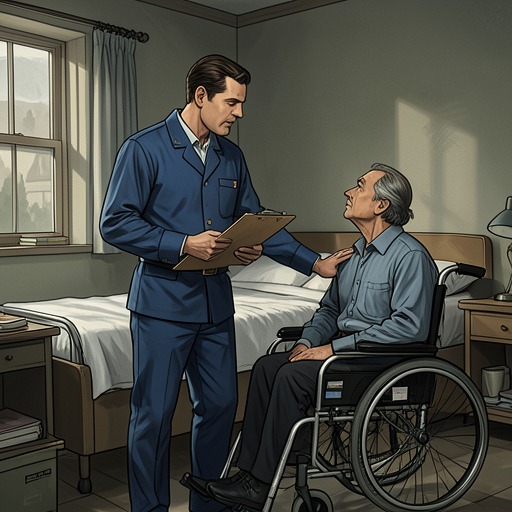
Charlie is being cared for on the first floor of Rivington House. Earlier on the night he dies, Dan has played checkers with him and found him unexpectedly lively for someone with acute myelogenous leukemia. By the time Dan reaches his room, however, Charlie is extremely frail and barely appears to be breathing. His age and illness are visible in his thinness and pallor, and he has bruises on his arm. Dan recognizes them as finger marks and suspects that Fred Carling, another patient, caused them; the scene presents Dan’s anger at this suspicion but does not establish further details about what happened.
Azzie is curled beside Charlie’s bed, keeping him company. Charlie recognizes that the cat and Dan have come for a reason, even as Dan initially gives an ordinary explanation for being there. Charlie says he is not in pain. His concern is not physical discomfort but the prospect of dying.
Final Hours with Dan Torrance
Charlie admits that he is scared, although he had not expected to be. He is not afraid of hell: he believes he has lived a decent life and doubts that hell exists. What troubles him is the possibility that death ends everything. Because there was nothing before birth, he reasons, perhaps there is nothing afterward either. His question makes the uncertainty of the moment explicit; he does not pretend to possess faith that would settle it.
Dan takes Charlie’s hand rather than checking his pulse. Through the shining, he experiences images from Charlie’s life: Charlie’s twin sons as young children on swings; his wife in a moment of intimacy and affection; a Farmall tractor beneath a striped umbrella; work tools, a radio, and a red barn reflected in rainwater. Other glimpses include food, hunting, fishing, dancing with his wife at an American Legion hall, and splitting wood. The memories move across different ages, from Charlie as a five-year-old with a red wagon to his adult life. They do not provide a complete biography, but together they suggest a life populated by family, work, and ordinary pleasures.
The images blur together and give way to the wind outside and the quiet of the room. Dan understands his presence there as the purpose of his work. He reflects that the suffering and sorrow he has lived through have brought him to this bedside, where he can accompany Charlie rather than leave him alone with fear. He tells Charlie that people do not really end, while acknowledging that he cannot explain how this is so or what it means. His assurance is an act of comfort, offered without claiming to resolve the mystery Charlie has raised.
Death and Significance
Dan wipes Charlie’s face with a damp cloth and remains with him as his breathing ends. After Charlie’s final exhalation, Dan waits for what he calls the last thing: a brief, dull red mist rising from Charlie’s nose, mouth, and eyes before fading above the body. An experienced nurse in Tampa had called this phenomenon the gasp; Dan has seen it at other deaths as well. Its recurrence places Charlie’s passing within the pattern of Dan’s work with the dying, while the scene keeps its focus on this particular man and his final fear.
Charlie’s death is significant less as a medical turning point than as an instance of care at the edge of what can be known. He asks whether nothing follows life, and Dan cannot offer proof. What he can offer is attention, a hand held through the final moments, and a response shaped by the memories that pass through him. Charlie’s final scene thus shows Dan’s role as a companion to the dying: he cannot prevent the loss, but he can meet the person facing it and help make the passage less lonely.